The plight of timeshare prisoners freed by European Consumer Claims, featured in The Sunday Times
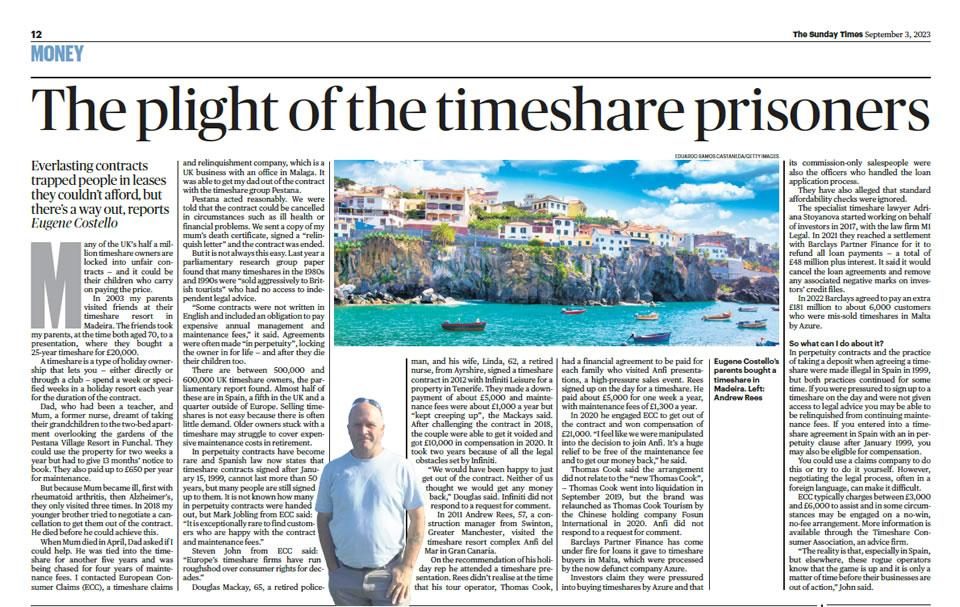
Everlasting timeshare contracts have trapped owners in unaffordable agreements — but there may be a route out, reports Eugene Costello
Hundreds of thousands of UK timeshare owners are tied into contracts they no longer want or can’t afford — and in some cases the liability can pass to their children. In 2003 my parents visited friends at their timeshare resort in Madeira. The friends took my parents, then both aged 70, to a presentation where they bought a 25-year timeshare for £20,000.
A timeshare is a form of holiday ownership that gives you — either directly or via a club — the right to use a particular resort apartment for a set week (or weeks) each year for the length of the contract, alongside ongoing annual fees.
Dad, a former teacher, and Mum, a retired nurse, imagined taking their grandchildren to a two-bedroom apartment overlooking the gardens of the Pestana Village Resort in Funchal. They could use the property for two weeks a year but had to give 13 months’ notice to book. They also paid up to £650 a year in maintenance.
But after Mum became ill — first with rheumatoid arthritis and later Alzheimer’s — they only went three times. In 2018 my younger brother tried to negotiate a cancellation to get them out of the contract. He died before he could resolve it.
When Mum died in April, Dad asked if I could help. He still had five years left on the agreement and was being chased for four years of maintenance arrears. I contacted European Consumer Claims (ECC), a timeshare claims and relinquishment company, a UK business with an office in Malaga. ECC was able to help my dad end the contract with the timeshare group Pestana.
Pestana acted reasonably. We were told the contract could be cancelled in circumstances such as ill health or financial difficulties. We provided a copy of my mum’s death certificate, signed a “relinquish letter”, and the contract was brought to an end.
But it is not always this straightforward. Last year, a parliamentary research group paper said many timeshares in the 1980s and 1990s were “sold aggressively to British tourists” who had no access to independent legal advice.
“Some contracts were not written in English and included an obligation to pay expensive annual management and maintenance fees,” it said. Agreements were often made “in perpetuity”, locking the owner in for life — and, after they die, potentially their children as well.
There are between 500,000 and 600,000 UK timeshare owners, the parliamentary report found. Almost half are in Spain, a fifth in the UK and a quarter outside Europe. Reselling a timeshare can be difficult because demand is often limited. Older owners who no longer travel may struggle to meet rising maintenance bills in retirement.
In-perpetuity contracts have become less common and Spanish law now states that timeshare contracts signed after 15 January 1999 cannot run for more than 50 years, but many people are still tied to long-term agreements. It is not known how many in-perpetuity contracts were issued, but Mark Jobling from ECC said: “It is exceptionally rare to find customers who are happy with the contract and maintenance fees.”
Steven John from ECC said: “Europe’s timeshare firms have run roughshod over consumer rights for decades.”
Douglas Mackay, 65, a retired policeman, and his wife, Linda, 62, a retired nurse, from Ayrshire, signed a timeshare contract in 2012 with Infiniti Leisure for a property in Tenerife. They paid a deposit of about £5,000 and maintenance was around £1,000 a year, but it “kept creeping up”, the Mackays said. After challenging the contract in 2018, they had it voided and received £10,000 in compensation in 2020. The process took two years because of legal obstacles set by Infiniti.
“We would have been happy just to get out of the contract. Neither of us thought we would get any money back,” Douglas said. Infiniti did not respond to a request for comment.
In 2011 Andrew Rees, 57, a construction manager from Swinton, Greater Manchester, visited the timeshare resort complex Anfi del Mar in Gran Canaria.
On the recommendation of his holiday rep, he attended a timeshare presentation. Rees did not realise at the time that his tour operator, Thomas Cook, had a financial arrangement to be paid for each family who attended Anfi presentations — high-pressure sales events. Rees signed up on the day for a timeshare, paying about £5,000 for one week a year, plus maintenance fees of £1,300 a year.
In 2020 he engaged ECC to help him exit the contract and won £21,000 in compensation. “I feel like we were manipulated into the decision to join Anfi. It’s a huge relief to be free of the maintenance fee and to get our money back,” he said.
Thomas Cook said the arrangement did not relate to the “new Thomas Cook” — Thomas Cook went into liquidation in September 2019, but the brand was relaunched as Thomas Cook Tourism by the Chinese holding company Fosun International in 2020. Anfi did not respond to a request for comment.
Barclays Partner Finance has come under fire for loans it provided to timeshare buyers in Malta, which were processed by the now-defunct company Azure.
Investors claim they were pressured into buying timeshares by Azure and allege that its commission-only salespeople were also the staff who handled the loan application process.
They have also alleged that standard affordability checks were ignored.
The specialist timeshare lawyer Adriana Stoyanova began working on behalf of investors in 2017, with the law firm M1 Legal. In 2021 they reached a settlement with Barclays Partner Finance for it to refund all loan payments — a total of £48 million plus interest. It said it would cancel the loan agreements and remove any associated negative marks on investors’ credit files.
In 2022 Barclays agreed to pay an additional £181 million to about 6,000 customers who were mis-sold timeshares in Malta by Azure.
So what can I do about it?
In Spain, in-perpetuity timeshare contracts and the practice of taking a deposit when agreeing a timeshare were made illegal in 1999, though both continued for some time afterwards. If you were pressured to sign on the day and weren’t given access to legal advice, you may be able to secure timeshare contract cancellation and avoid ongoing maintenance fees. If you entered into a timeshare agreement in Spain with an in-perpetuity clause after January 1999, you may also be eligible for compensation.
You can try to handle a timeshare relinquishment yourself or use a specialist claims company. However, dealing with a legal process — often overseas and in a foreign language — can make it harder to navigate.
“The reality is that, especially in Spain, but elsewhere, these rogue operators know that the game is up and it is only a matter of time before their businesses are out of action,” John said.
Source: https://www.thetimes.co.uk/article/what-is-timeshare-scams-uk-news-j7jr0937f
Related Posts

World’s third largest timeshare company accused of deception and customer abuse ‘Bonus’ weekend stay Greenwich social worker Raymond Hill, 53 and his wife Anthonia were invited to what seemed like a...

Sizeable Marriott award payout as members move to claim compensation for illegal contracts Happy owners Myra Bromfield, 55, and husband John bought their first two weeks of Marriott timeshare around 1998, at the Marri...
Spanish law 4/2012 has been updated to include a controversial 'sunset clause,' meaning that timeshare claims now have a time limit Decades of consumer abuse Since the early 1980s timeshare companies have been enrichi...

Following the discontinuation of the sales department more than four years ago, CLC World have started once again to sell timeshare points. Since they paused their timeshare sales operation in 2021, CLC have focused on...